Mechanical Engineering · San Diego State University

I design, build, and test hardware that flies and drives.

I'm Devin Yarak, a mechanical engineering student focused on small UAS, propulsion, and electric drivetrains. My work runs from benchmarking brushless motors on a thrust stand to designing Formula SAE drivetrain mounts and tuning autonomous flight controllers.

  • 14 + 16motors and propellers bench-tested
  • 18engineers led on a 48 kg rover
  • −22%FSAE drivetrain assembly mass at FoS ≥ 2.0
  • −42%FSAE cooling-system power draw

01

About

Headshot of Devin Yarak in a navy blazer and white shirt
FIG. AD. Yarak

I'm an Orange County local studying mechanical engineering at San Diego State University. I got into engineering by building and flying FPV drones, and that grew into evaluating propulsion systems and developing autonomous platforms.

That path led to independent bench testing of 14 brushless motors and 16 propellers, and now research in SDSU's Systems and Intelligence (SMILE) Lab. There I configure PX4 autopilots, tune controllers for GPS-denied flight, and help develop an in-house UAS platform.

I've also learned how to build hardware as part of a team. At OC Robotics I led an 18-member mechanical team through the design and integration of a 48 kg rover. I've carried those lessons into SDSU Formula SAE Electric, where I work on the drivetrain, cooling, and aerodynamics teams. What I enjoy most is coordinating across subsystem interfaces and using test results to improve the whole system.

I'm especially interested in UAS, defense, and autonomous systems, and I'm looking for Summer 2027 mechanical engineering internships.

Education

  • San Diego State UniversityB.S. Mechanical Engineering · GPA 3.4
    May 2028
  • Orange Coast CollegeA.S. Engineering · GPA 3.3
    May 2026

02

Projects

Seven projects across research, competition teams, and independent testing. The ones marked Report include a full technical report.

  1. P-01Small Brushless Motor EvaluationPersonal · 2026Report
  2. P-023–3.5 in Open Propeller TestingPersonal · 2026Report
  3. P-03EMRAX 208 Dynamometer Test BenchSDSU FSAE · 2026Report
  4. P-04GPS-Denied Autonomous UASSMILE Lab · 2026–
  5. P-05FSAE Drivetrain & CoolingSDSU FSAE · 2026–
  6. P-06FSAE Aerodynamics PackageSDSU FSAE · 2026–
  7. P-0748 kg Competition RoverOC Robotics · 2025–26

P-01 · UAV Propulsion Testing Program

Small Brushless Motor Comparative Evaluation

Personal projectMar – Aug 2026Owner & sole tester

  • Thrust stand
  • Flywheel dynamometer
  • Step response
  • Data analysis

Fourteen motors for sub-250 g, 3-inch FPV aircraft (twelve 1404-class, one 1504, one 1505), all tested on the same HQProp T3x3x3 propeller. The goal was to find useful performance balance, not just pick the motor with the highest advertised KV or peak thrust.

Method

  • Measured KV: no-load RPM at 7 V, read optically. Measured values came in up to 10.4% below the advertised rating.
  • Thrust sweep: 0–100% throttle at about 16 V, logging RPM, thrust, torque, voltage, current, and power.
  • Efficiency: mechanical output (τω) divided by electrical input, compared at a common 50 W output.
  • Torque: an inertial flywheel dynamometer spun from 5,000 to 20,000 RPM, with torque inferred from angular acceleration.
  • Responsiveness: repeated 10→50→10% throttle steps, averaging acceleration and braking rates.
  • Scoring: cohort-relative scores (100 = average), plus a weight-normalized score for mass-critical builds.

Key findings

  • Advertised KV didn't predict loaded performance. Measured KV ranged from 2,915 to 4,428.
  • The iFlight XING 1504 had the highest raw score (117.9), but its 11.2 g mass dropped it to 98.5 once weight was counted.
  • The T-Motor F1404 4600KV was the best all-around motor: above average in every category and lighter than average.
FIG. 1 Weight-normalized score by motor (cohort average = 100)
  1. T-Motor F1404 4600117.5
  2. Happymodel EX1404 3500111.9
  3. Skystars 1404 3800108.2
  4. BetaFPV 1404 4500103.9
  5. Flyfish Flash 1404 4500101.5
  6. Holybro Ripper 1404 3800100.6
  7. Brotherhobby 1404 380099.2
  8. iFlight XING 1504 390098.5
  9. SpeedyBee 1404 450098.0
  10. EMAX ECO 1404 370096.9
  11. BetaFPV 1404 380096.4
  12. MEPS SZ 1404 290095.7
  13. TBS Podracer 1505 360091.9
  14. iFlight XING2 1404 380084.0
TABLE 1 Recommendations by mission
PriorityMotorEvidence
Best all-around 1404T-Motor F1404 4600KV8.9 g · 408 gf · 70.4% · fastest response (176 kRPM/s)
Max raw performanceiFlight XING 1504 3900KV414 gf · 36.9 mN·m · 11.2 g
Long-range / cruiseHappymodel EX1404 3500KVLightest at 8.1 g · best efficiency at 73.4%
Balanced moderate KVSkystars 1404 3800KVHighest 1404 torque (32.8 mN·m) · 366 gf · 71.8%

P-02 · UAV Propulsion Testing Program

3-Inch and 3.5-Inch Open Propeller Testing

Personal projectMar – Aug 2026Owner & sole tester

  • Tyto-style 1585 stand
  • Shaft-power analysis
  • Vibration
  • Normalized scoring

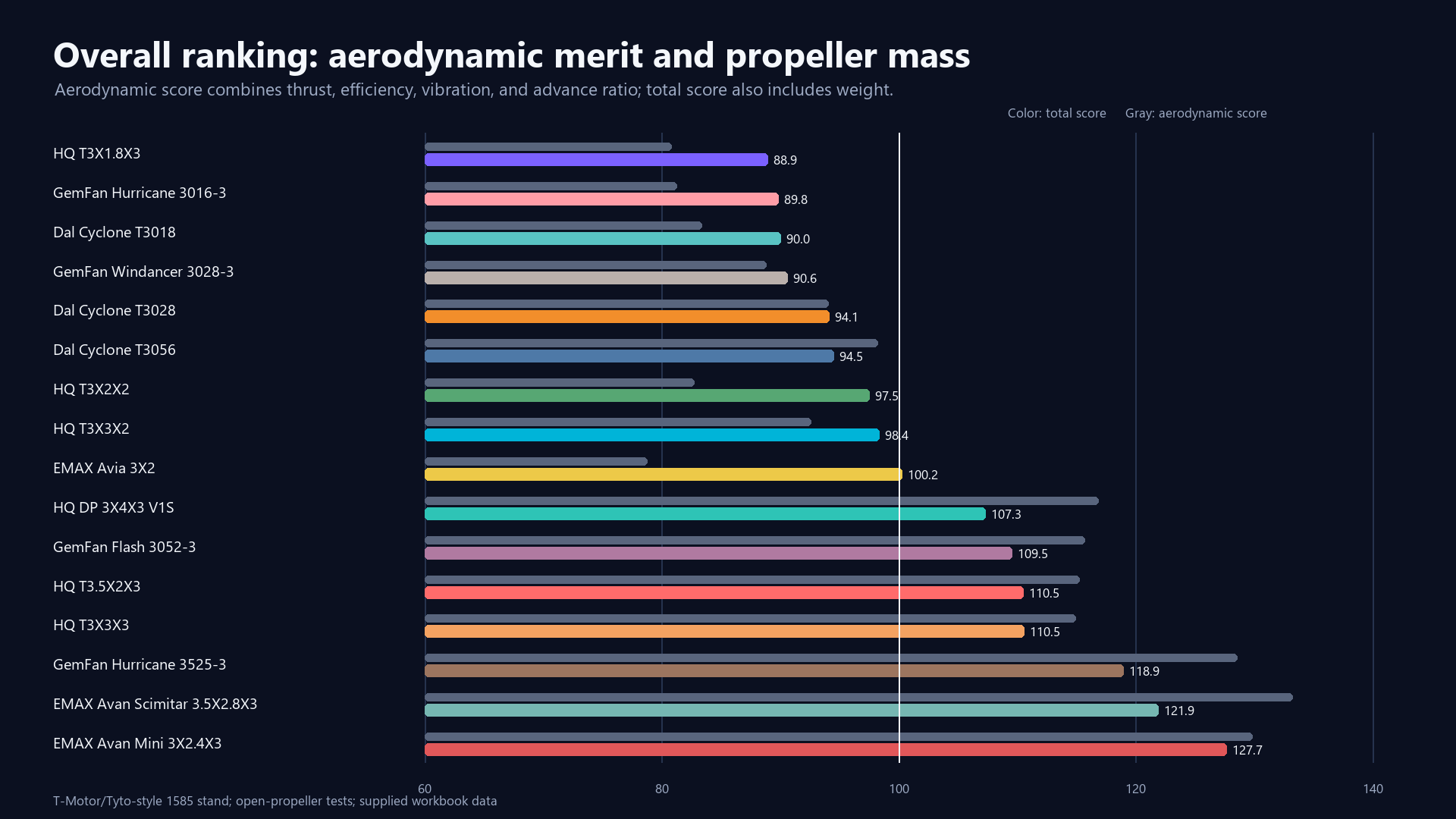
A static bench comparison of 16 open propellers (thirteen 3-inch and three 3.5-inch) on a 1504 motor, with a 4S battery backed by an external supply to reduce sag. The stand ran in a pusher configuration with optical RPM, load-cell thrust and reaction torque, and ESC-side voltage and current.

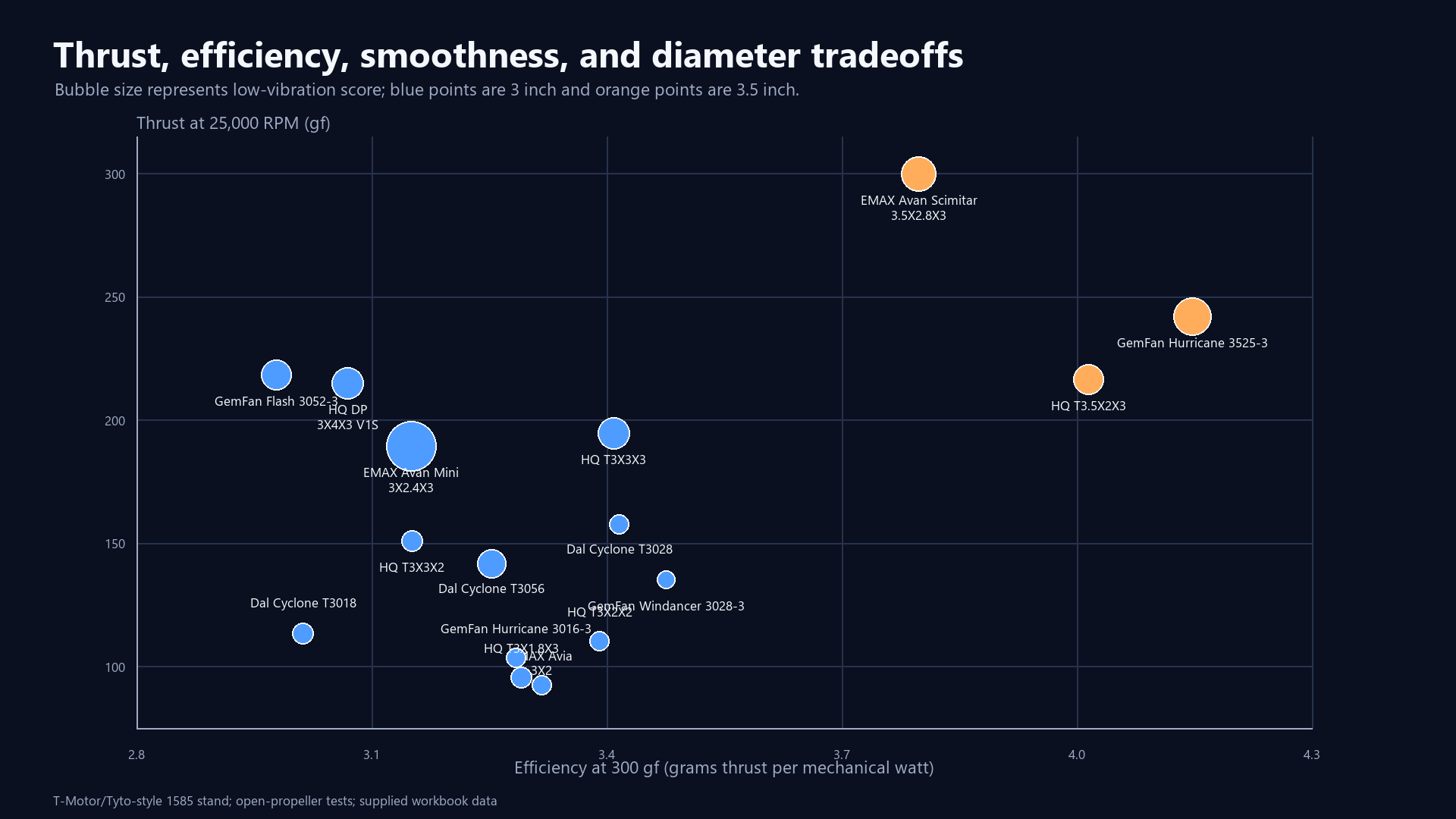
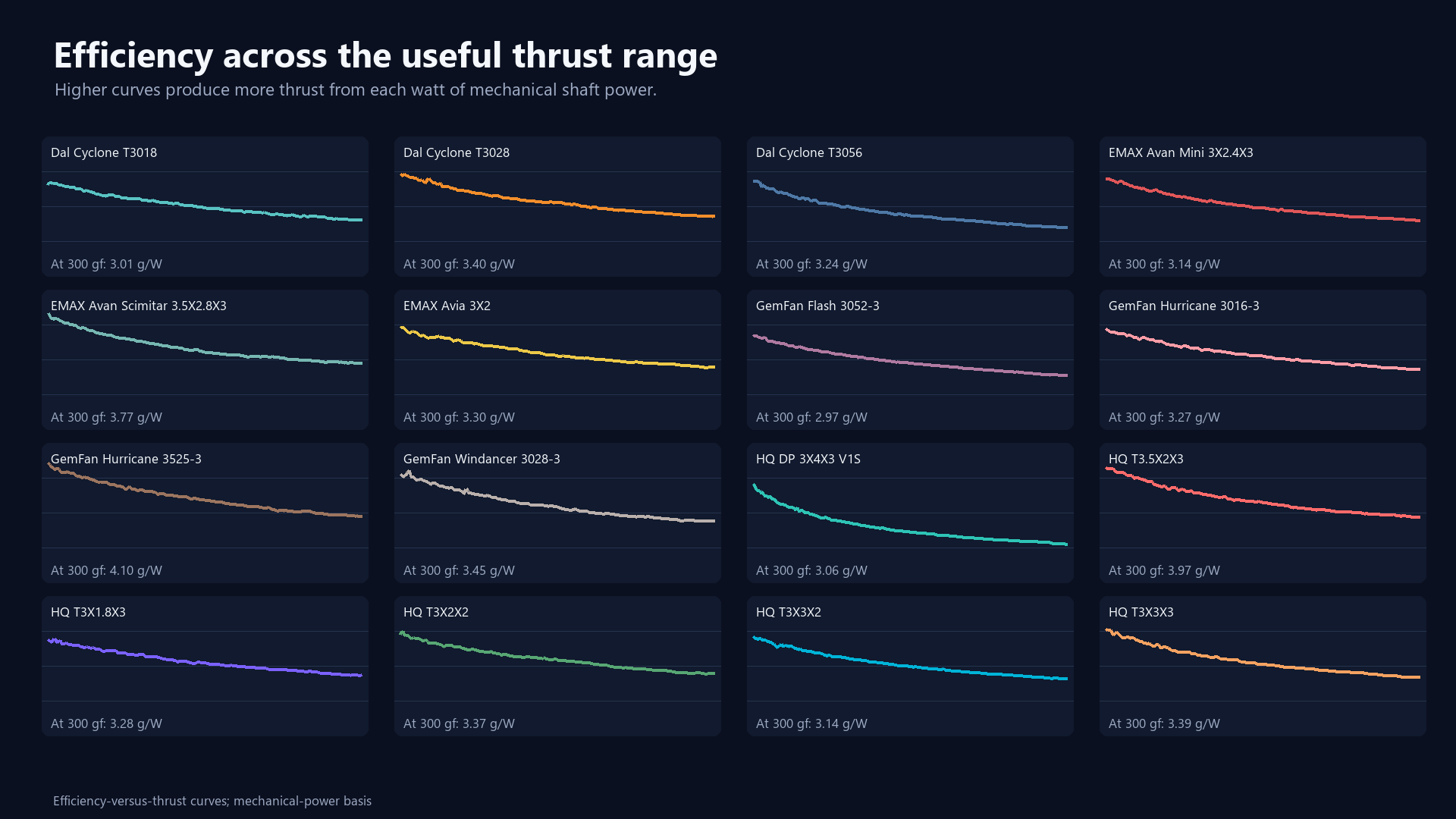
Electrical power depends on the motor, so I compared propellers by mechanical shaft power, Pm = τω = τ(2πN/60), with efficiency taken as grams of thrust per shaft watt at a common 300 gf point.

Key findings

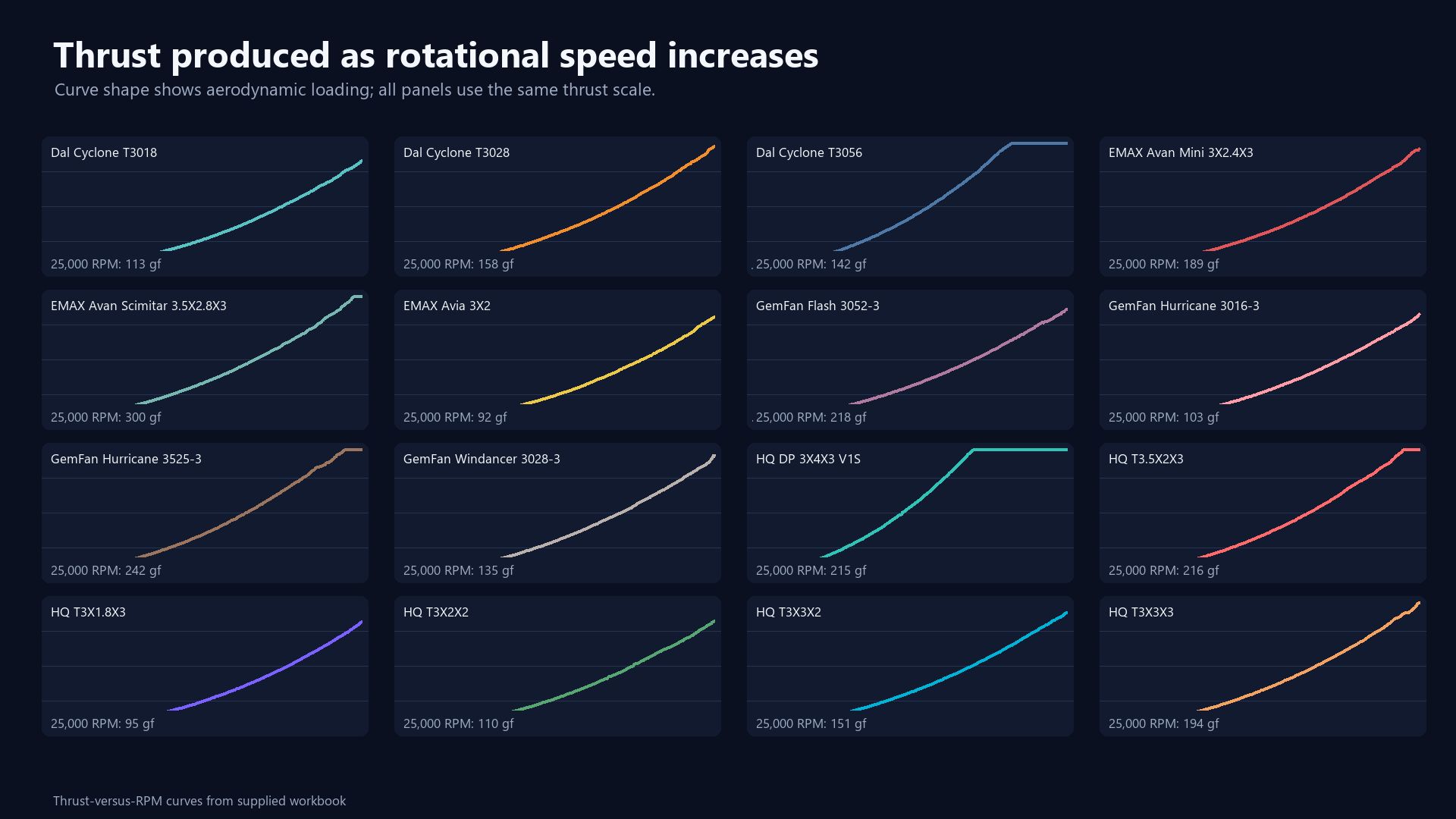
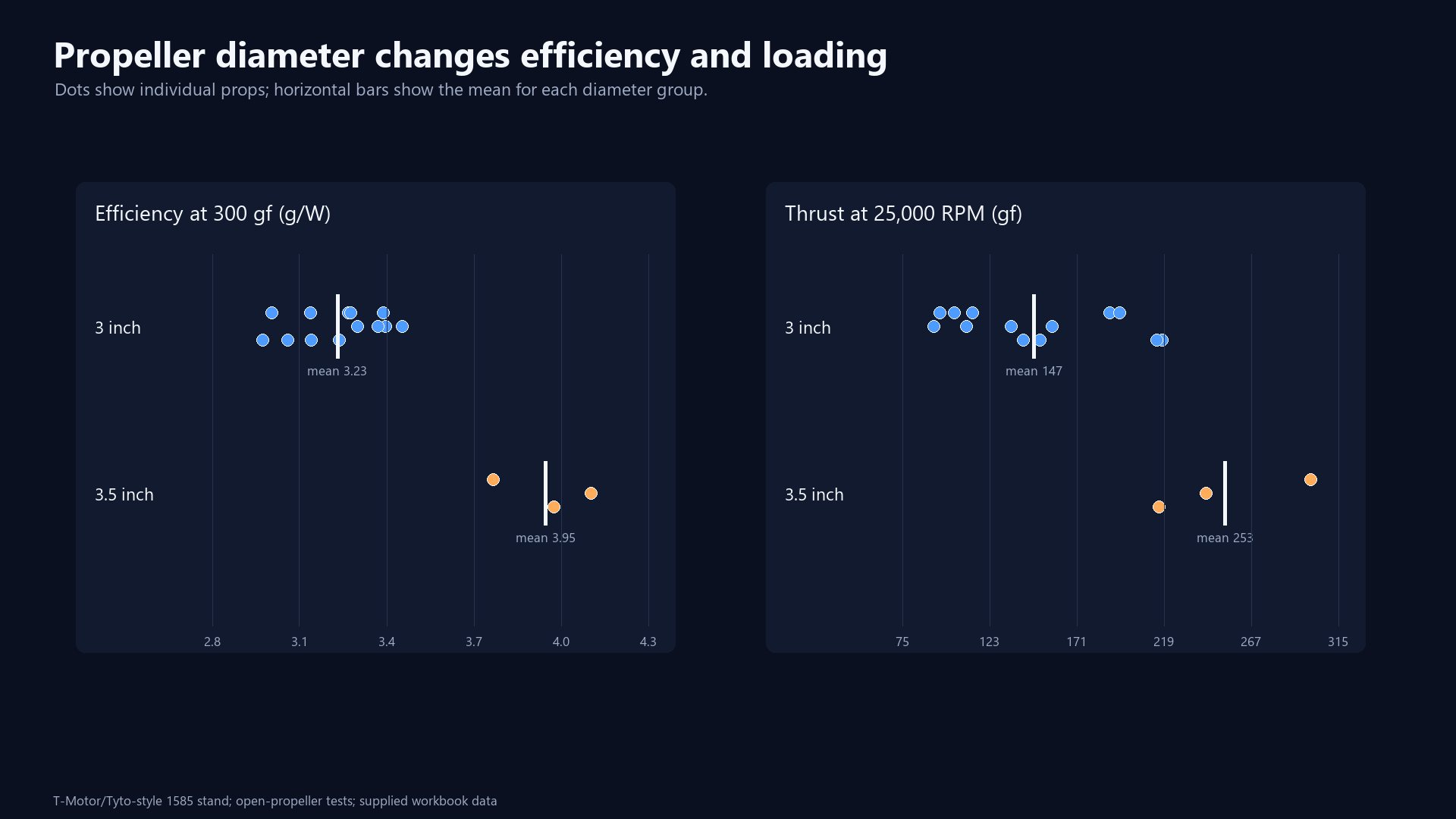
  • The 3.5-inch group averaged 22% higher efficiency (3.95 vs 3.23 g/W) and 72% more thrust at 25,000 RPM (253 vs 147 gf), at the cost of more mass, torque demand, and frame clearance.
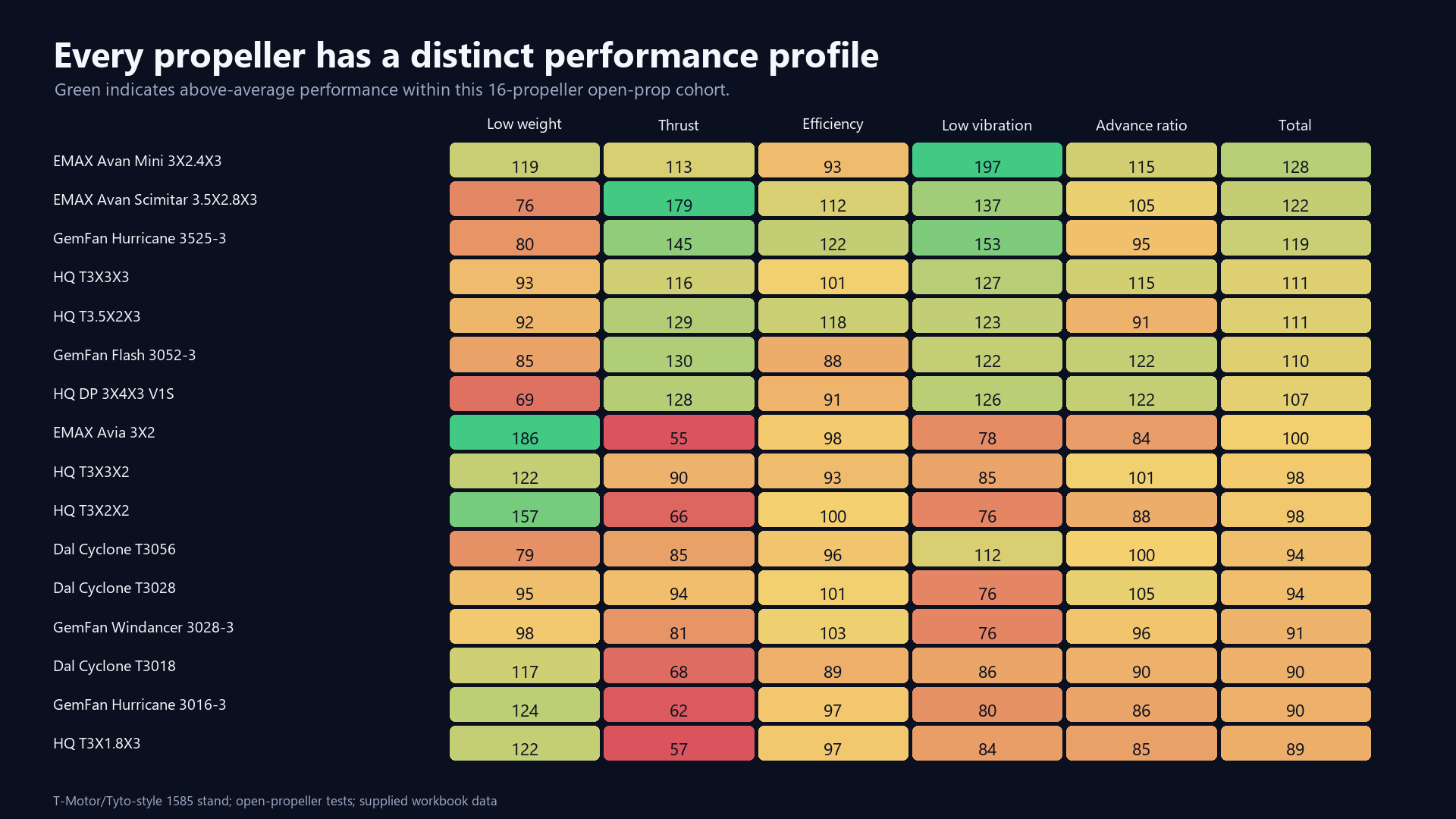
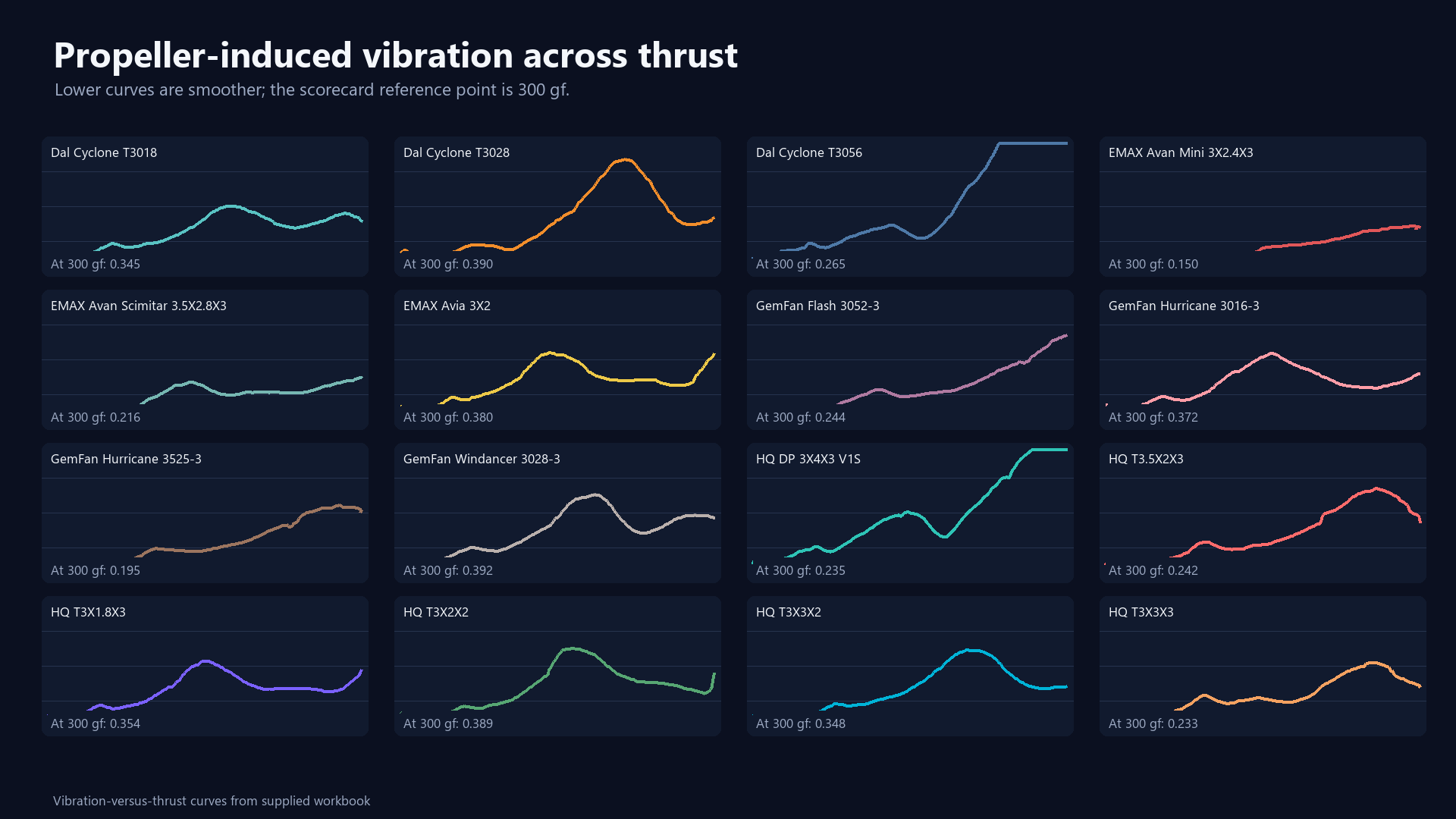
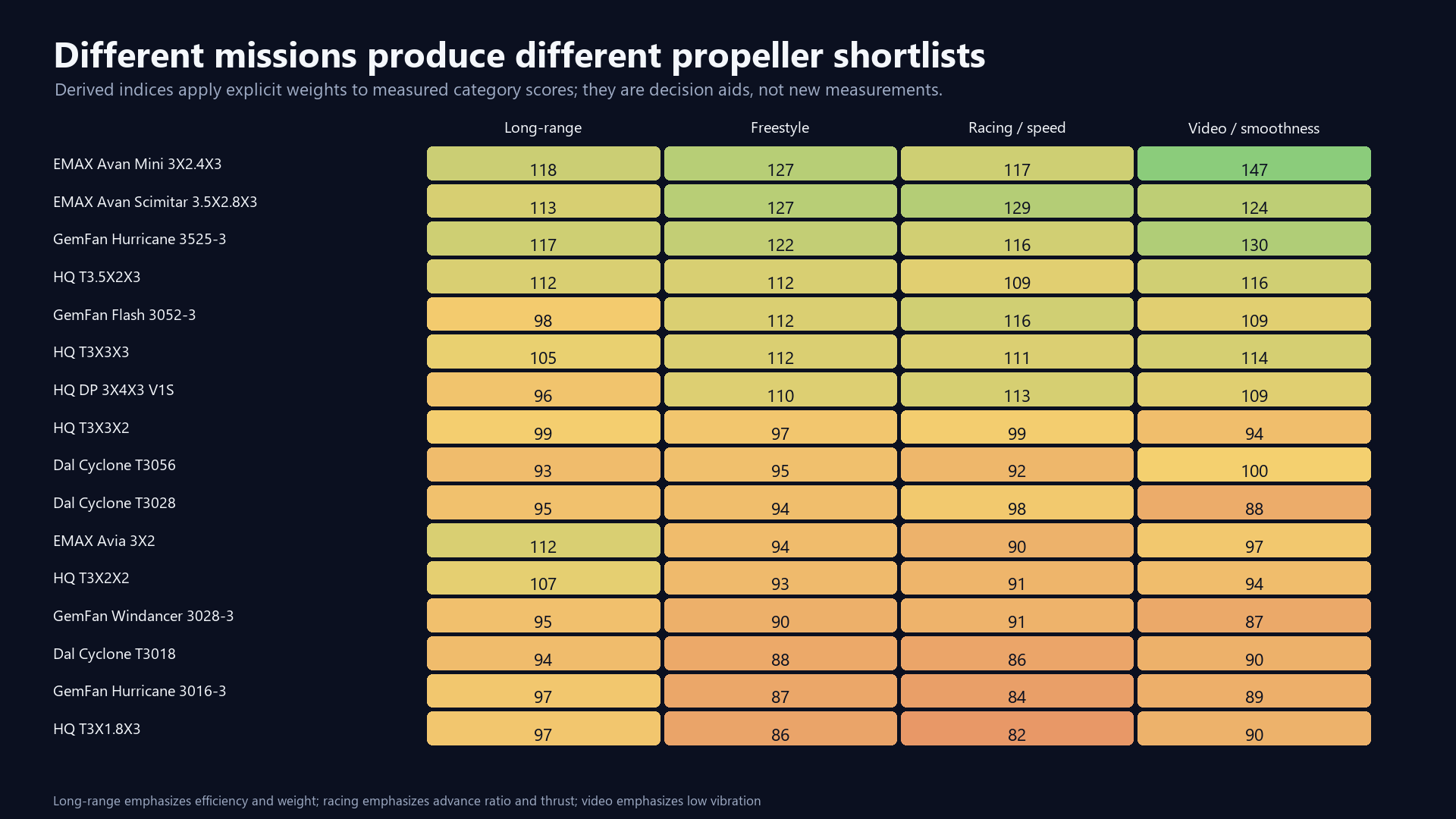
  • The EMAX Avan Mini 3X2.4X3 was the best 3-inch package (score 127.7), with by far the lowest vibration.
  • The GemFan Hurricane 3525-3 led the cohort in efficiency (4.10 g/W). The EMAX Avan Scimitar 3.5 had the most thrust (299.7 gf at 25k RPM).
  • I flagged a mismatch in the vibration reference (200 vs 300 gf) between the notes and the workbook, and treated the workbook as the source of record.
TABLE 2 Category leaders
DistinctionPropellerMeasured basis
Best overall 3-inchEMAX Avan Mini 3X2.4X3127.7 total · lowest vibration
Highest static thrustEMAX Avan Scimitar 3.5X2.8X3299.7 gf @ 25,000 RPM
Highest efficiencyGemFan Hurricane 3525-34.10 g/W @ 300 gf
Highest speed proxyGemFan Flash 3052-3Advance ratio 0.1627
Lowest massEMAX Avia 3X20.80 g

P-03 · Competition Team

EMRAX 208 Motor & Drivetrain Dynamometer Test Bench

SDSU Formula SAE Electric RacingOct 2026Engineering planning report author

  • Four-quadrant dyno
  • Sensor sizing
  • Datasheet analysis
  • Commissioning plan

For SDSU Formula SAE Electric Racing, I wrote a planning report for a regenerative, four-quadrant electric dynamometer to characterize the team's EMRAX 208 motor driving a 4.7:1 reduction under steady and transient loads. A second electric machine absorbs or drives the device under test, with measured shaft torque and speed. The report sets the architecture, sizing basis, measurement channels, risks, and staged commissioning before any hardware is bought.

Engineering decisions

  • Output torque sensor: I checked the provisional 800 N·m transducer against a 705 N·m ideal peak. That leaves only 11.9% headroom, or 16.3% at an assumed 95% drivetrain efficiency, and those are static margins that inertia, backlash, and torque reversal can use up.
  • Motor-side measurement: I recommended a separate 200–300 N·m transducer rather than relocating the output sensor (rated 6,000 rpm against a 7,000 rpm peak), so drivetrain efficiency can be isolated during transients.
  • Datasheet envelope: I showed that the headline 150 N·m, 7,000 rpm, and 80 kW figures are independent maxima, not one rectangular operating envelope, so commissioning has to stay inside verified curves.
  • Structure: a heavy welding table as the common foundation, with modular motor, gearbox, sensor, and load-machine plates that have locating features and alignment adjustment.
EMRAX 208DUT motor T/ω200–300 N·m Reduction4.7 : 1 T/ω800 N·m Load machineabsorb / drive (4-quad) shared DC bus · regenerative energy return Welding-table foundation · modular mounting plates
FIG. 4 Bench power path: motor-side and output-side torque/speed transducers bracket the gearbox.

P-04 · Research

GPS-Denied Autonomous UAS Platform

Systems and Intelligence (SMILE) Lab, SDSUSep 2026 – PresentUndergraduate Researcher

  • PX4
  • ROS 2
  • PID tuning
  • NDAA compliance

I'm developing an in-house small UAS platform and the autonomy stack it runs, aimed at reliable flight without GPS. I work across the airframe and the flight software, optimizing mechanical properties while integrating autopilot and companion-computer software.

  • Configure PX4 autopilot parameters and filters, and tune PID controllers for GPS-denied autonomous flight.
  • Program and integrate ROS 2 software with the flight controller.
  • Develop the airframe toward NDAA compliance, a 2 kg payload, and ±5 cm positioning accuracy.
  • Fly under my FAA Part 107 Remote Pilot Certificate.

P-05 · Competition Team

Formula SAE Electric Drivetrain Mounts & Cooling System

SDSU Formula SAE Electric RacingAug 2026 – PresentDrivetrain & Cooling Team Member

  • SolidWorks
  • ANSYS FEA
  • Cooling design
  • Data acquisition

Drivetrain structure

  • Designed and fabricated motor mounts and drivetrain brackets in SolidWorks, validated with ANSYS FEA.
  • Cut assembly mass by 22% while holding a minimum 2.0 factor of safety.

Cooling system

  • Redesigned cooling-system packaging and flow paths, cutting power consumption by 42% and mass by 18%.
  • Built an 8-channel temperature and flow data-acquisition system to validate the thermal design.

P-06 · Competition Team

Formula SAE Electric Aerodynamics Package

SDSU Formula SAE Electric RacingAug 2026 – PresentAerodynamics Team Member

  • SolidWorks
  • ANSYS CFD
  • Composites
  • Track correlation

Alongside my drivetrain and cooling work, I'm on the aerodynamics sub-team, which develops the car's wings and underbody to add cornering grip while managing drag and aero balance. Because I sit on both teams, I also coordinate packaging where the aero surfaces meet the cooling ducts and drivetrain.

  • Model and iterate aerodynamic surfaces, including wing elements, endplates, and undertray and diffuser geometry, in SolidWorks.
  • Run ANSYS CFD studies to compare configurations on downforce, drag, and front-to-rear balance.
  • Support fabrication of composite aero components and design their mounting hardware.
  • Help plan on-track validation so CFD predictions can be checked against measured data.

P-07 · Competition Team

48 kg Competition Rover: Mechanical Team Lead

OC Robotics, Orange Coast CollegeAug 2025 – Aug 2026Mechanical Team Lead

  • Team leadership
  • SolidWorks
  • ANSYS FEA
  • Field testing
  • Led an 18-member mechanical team through the design and integration of a 48 kg rover.
  • Designed 38+ components in SolidWorks and ANSYS FEA, cutting structural mass by 17%.
  • Ran fabrication and tolerance reviews to reach 95% first-pass assembly fit.
  • Drove 40 hours of field testing to find and resolve mechanical issues before competition.

03

Experience

Engineering

  1. Sep 2026 – Present

    Undergraduate Researcher, UAS Development

    Systems and Intelligence (SMILE) Lab, San Diego State University

    PX4 configuration, PID tuning, and ROS 2 integration for GPS-denied autonomous flight, plus development of an in-house NDAA-targeted UAS. See project P-04

  2. Aug 2026 – Present

    Drivetrain and Cooling Team Member

    SDSU Formula SAE Electric Racing

    Motor mounts and drivetrain brackets (−22% mass, FoS ≥ 2.0), a cooling redesign (−42% power, −18% mass) with an 8-channel DAQ, and the EMRAX 208 dynamometer test bench plan. See projects P-03 and P-05

  3. Aug 2026 – Present

    Aerodynamics Team Member

    SDSU Formula SAE Electric Racing

    Aero surface modeling in SolidWorks, ANSYS CFD comparisons of downforce, drag, and balance, plus composite fabrication support and coordination of aero packaging with cooling. See project P-06

  4. Mar 2026 – Aug 2026

    Small UAV Propulsion Testing

    Personal project

    Bench-tested 14 brushless motors and 16 propellers for thrust, torque, RPM, efficiency, and transient response, and turned the results into ranked component shortlists. See projects P-01 and P-02

  5. Aug 2025 – Aug 2026

    Mechanical Team Lead

    OC Robotics, Orange Coast College

    Led an 18-member team on a 48 kg rover: 38+ components, −17% structural mass, 95% first-pass fit, and 40 hours of field testing. See project P-07

Other experience

  • Valet Parking AttendantSVS Parking
    Feb 2026 – Aug 2026
  • Barista and ServerElixir Tea Bar
    Jan 2025 – May 2026
  • OperationsThe Rinks
    Mar 2023 – Jan 2025

04

Skills

Design & Analysis

  • SolidWorks
  • ANSYS FEA
  • ANSYS CFD
  • MATLAB
  • Python

Test & Instrumentation

  • Propulsion testing
  • Thrust stands
  • Flywheel dynamometry
  • Data acquisition
  • Arduino / ESP32

Fabrication

  • FDM / SLA 3D printing
  • CNC milling & turning
  • Laser cutting
  • Welding
  • Electrical assembly

Autonomy & Controls

  • PX4 autopilot
  • ROS 2
  • PID tuning & filtering
  • Betaflight

Certifications

  • FAA Part 107 Remote Pilot
  • FCC Amateur Radio (HAM) License

Outside the lab

  • FPV building & racing
  • Leatherworking
  • Rock climbing
  • Backpacking
  • PC building

05

Contact

I'm looking for Summer 2027 mechanical engineering internships, especially in UAS, propulsion, and autonomous systems. I'd be glad to talk.